Archive for the ‘Troubleshooting’ Category

Locate default Computer or User OU

In troubleshooting an issue with the SBS user creation wizard, I wanted to know what was set as the default Organizational Unit in which users would be placed.   Though the following works with any server version which is domain functional level Server 2003 or newer, SBS defaults to placing users in the MyBusiness\Users\SBSUsers OU and I wanted to verify this was set appropriately.  There are 100 articles explaining how to change the default users OU using the command “Redirusr”, or “Redircmp” for computers, but it was difficult to find a link explaining how to locate the current defaults.  There are a few links explaining where the information is stored, which is in the “wellKnownObjects” attribute of the properties of the domain, in Active Directory Users and Computers.

image

However when you click on “View”, to inspect the settings for that attribute, you get a popup warning; “There is no editor to handle this attribute”, and the same happens when using ADSI Edit.

image

Thanks to a tip by Alex Verboon, using Microsoft’s (Sysinternal’s) Active  Directory Explorer will allow you to see the settings of this attribute.  Download AD Explorer, run the app, on a single domain server you can live all fields blank and click OK.

image

Click on your domain, then in the right hand window right click on wellKnownObjects”, and choose properties.

image

In the resulting window you can review the current settings for the default OU’s for Computers and Users

image

image

Sharepoint update KB2596911 on SBS

I just installed “Security Update for Windows Services 3.0 x 64 KB2596911” on a clients SBS 2008 server, as 1 of 6 updates, only to have it fail.  Upon reboot neither Sharepoint website or the WSUS console were functioning.  In addition the Application Event Log was full of Event ID 5084, Source MSSQL$MICROSOFT##SSEE informational events.  A quick Google showed many folk have encountered similar issues, for example:

http://social.technet.microsoft.com/Forums/en-US/sharepointadmin/thread/e8391454-a5b2-418f-8dab-324c430ce219

In my case after the reboot I was able to resolve by downloading the single update from the link below, right clicking and choosing run as administrator, and wait, and wait, and wait!  Be patient, the update though small took about 45 minutes to complete but it was successful, and all services restarted.  Though it did not prompt for a reboot I felt it was best to do so and everything still functioned properly.

http://www.microsoft.com/en-us/download/details.aspx?id=30274

For the record, there is no mention of it in the KB article, but during the install it advises that you need volume licensing to use the update.  I choose to accept the notification and continue, working on the assumption the licensing referred to the base product.  In my case this was being installed on Small Business Server where Sharepoint is an integrated component.

This may not be a solution in all cases, but it was a simple, though tedious, repair for this server.

Yahoo Mail Down

Having had a couple of calls; “I can’t log into Yahoo Mail” I decided to follow up.  It seems the internet is all a “Twitter” with reports from numerous countries that Yahoo Mail has been off-line for a couple of hours now.   This combined with last weeks hack of >400,000 mail accounts cannot be good for business.  Ironic that today’s top story on CNN is about Marissa Mayer the new CEO of Yahoo.

You can view the current status of Yahoo Mail on-line/off-line at http://downrightnow.com/yahoomail

Remote PC firewall on or off ?

I was asked; “how can I tell from a command line if the firewall is enabled on a PC on our network, using a command line?”

Netsh is a very powerful tool for querying and setting the status of most anything network related. There are both the ‘netsh firewall’ and ‘netsh advfirewall’ options depending if XP, or Vista and newer.  I will deal with the advanced firewall as it is commonly used with Vista and Win 7 these days. The following command will return the available options:

C:\>netsh advfirewall show

The following commands are available:

Commands in this context:
show allprofiles – Displays properties for all profiles.
show currentprofile – Displays properties for the active profile.
show domainprofile – Displays properties for the domain properties.
show global    – Displays the global properties.
show privateprofile – Displays properties for the private profile.
show publicprofile – Displays properties for the public profile.
show store     – Displays the policy store for the current interactive session.

As you are aware the Advanced firewall can be set differently for domain, home, or public networks.  We are concerned with how it is set now, while on our network so we will use the show currentprofile option.  The result returns numerous details. By piping the results to the find command we can limit the output and simply determine if the Windows firewall is on or off  ( note: /I ignores case of the text in quotes):

C:\>netsh advfirewall show currentprofile |find “State” /I
State                                 OFF

Chances are you will not want to run to the machine to check so you can make use of Sysinternals/Microsoft’s PSexec to run netsh, or any command, on a remote machine.  You will need to run this with admin privileges for the remote machine. Therefore it is generally done from the server using a domain admin account.

C:\PSTools>psexec \\PC1 netsh advfirewall show currentprofile |find “state” /I

PsExec v1.98 – Execute processes remotely
Copyright (C) 2001-2010 Mark Russinovich
Sysinternals – http://www.sysinternals.com

Starting netsh on PC1…ice on PC1…
State                                 OFF
(the output will often end with the following when run remotely: netsh exited on PC1 with error code 0.)

PSexec can be downloaded for free from: http://technet.microsoft.com/en-us/sysinternals/bb897553.aspx

WSUS Update KB2720211 Issues

There have been numerous problems reported after installing Microsoft update KB2720211

  • WSUS server stops synchronizing with Microsoft Update
  • Website Verifications are not accurate
  • WSUS server stops working and also fails to reinstall
  • Errors in errorlog for Windows internal database
  • Some have reported backups fail to run on SBS

Should any of these be plaguing your systems Microsoft just released a TechNet Blog article addressing these issues which may be of some help:

http://blogs.technet.com/b/sus/archive/2012/06/20/wsus-kb272011-common-issues-encountered-and-how-to-fix-them.aspx

If interested in reading about end user reports, currently the key links to follow are:

http://social.technet.microsoft.com/Forums/en-US/winserverwsus/thread/e918a191-ef6d-4c4b-b83a-7a4ae20a5217

http://byronwright.blogspot.nl/2012/06/kb-2720211-kills-wsus.html

http://tinyurl.com/c2clhht

http://www.experts-exchange.com/OS/Microsoft_Operating_Systems/Server/SBS_Small_Business_Server/Q_27758486.html#a38107387

Google/Bing KB2720211 to locate more.

SBS connect / connectcomputer wizard fails

Generally when a computer cannot join the domain using http://connect (SBS 2008 & 2011) or http://SBSname/connectcomputer (SBS 2003) it is due to inability to correctly resolve the name of the domain controller in a timely fashion. Below is a list of common reasons for the connect wizards to fail.

In an SBS domain, the server should be the DHCP server, and if so, items 3 and 4 below should be automatically set through DHCP.  However if addressing is statically assigned or you are using a router you may need to make changes. Items 3 and 4 are also basic networking requirements of a Windows Domain, not just important for joining the domain.

1. If there is more than 1 network adapter installed, wired or wireless, disable all but 1 until domain joined.  If at all possible, make it a wired connection, not wireless. 

2. Many new PC’s also show a Bluetooth connection under “Network Connections”, this should be disabled as well while running the wizard.  If you are using a Bluetooth mouse and/or keyboard these will have to be temporarily replaced.

3. Make sure, using IPconfig /all, that the client’s DNS points ONLY to your internal DNS servers, in this case the SBS.  Do not allow a router or ISP to be added even as an alternate.

4. IPconfig /all should also show next to “Primary DNS Suffix”” your internal domain suffix such as MyDomain.local.  If not you need to add the domain suffix to the client machine. To do so insert it in the “DNS suffix for this connection” box under the DNS tab of the NIC’s advanced TCP/IP IPv4 properties

5. If there are any 3rd party firewalls or security suites installed, disable them until joined to the domain.  The Windows firewall should not need to be disabled.

6. If still failing add the connect web site to the “trusted” sites list in Internet Explorer under Tools | Internet Options | Security |trusted Sites

7. If all else fails you can skip the wizard and use a 3rd party utility called ProfWiz.  

It is important to note that using the connect and connectcomputer wizards is very important.  With SBS 2003 it is especially critical to do so as it performs a long list of tasks other than just joining the domain.  It copies the local user’s profile, configures the user and computer environments, changes permissions, installs SBS related features, makes changes to networking, and much more.  Susan Bradley’s blog outlines this in detail: “So exactly “what” does connect computer do anyway?”  However SBS 2008 and SBS 2011 control most of this through Group Policy.  The key bonus feature with the SBS 2008/2011 wizard is its ability to import current users’ local profiles. Though I still strongly recommend using the wizard, it will only import a local workgroup profile.  If the wizard fails or you are wanting to import a previous domain profile, you may want to consider using Profwiz.  Profwiz by forensit.com a simple little tool that will join the PC to the domain and reset the permissions of an existing profile allowing it to be used as the new domain profile (i.e. import users settings like desktop items, favorites, Documents, and application configurations). For instructions on downloading and running see:  https://blog.lan-tech.ca/2011/05/19/sbs-and-profwiz/

SBS Missing Attributes tab in AD

It seems the Attributes tab is missing on the user profile in Active directory after a migration from SBS 2003 to SBS 2008 and SBS 2011.  Normally this is hidden, but easily reviled by selecting on the AD menu bar; View, and then Advanced Features, however this is not so after a migration.  The issue was addressed in a post by Stuart Hudman  http://social.technet.microsoft.com/forums/en-US/winserverManagement/thread/6e6ef6bd-b5c9-4f16-b346-097832e3b93c/  but I was recently asked to help locate the exact location for the required changes, so I have posted detailed instructions below.

As always, you should have a good backup, including system state, before editing AD.
Note: the values to add, such as “11,{c7436f12-a27f-4cab-aaca-2bd27ed1b773}” need to be exact , without quotes. All three entries are similar but copy carefully as they are not the same. There will probably be multiple entries already present under the attribute, you are just adding one more….assuming it is not already present, which you should check first.

-open ADSIedit.msc
-at the top of the ‘tree’ right click on ADSIedit and choose “connect to”
-under connection point select “select a well known Naming context” and in that window choose “Configuration”
-under computer leave as “Default (Domain or server that you logged into)” Assuming you are logged onto the SBS
-click OK
-expand (click on the +) CN=configuration, DC=<your domain>, DC=local
-expand CD=DisplaySpecifiers
-click on CN=your language. The language # can be found on http://support.microsoft.com/kb/324097 (for example US English is 409, so CN=409  (this is the language you chose when setting up the server)
-in the right hand window locate CN=User-Display right click on it and choose properties.
-Locate AdminPropertyPages, highlight it and click “edit” and add the line 11,{c7436f12-a27f-4cab-aaca-2bd27ed1b773}
-in the right hand window locate CN=Computer-Display right click on it and choose properties.
-Locate AdminPropertyPages, highlight it and click “edit” and add the line 12,{c7436f12-a27f-4cab-aaca-2bd27ed1b773}
-in the right hand window locate CN= Default-Display right click on it and choose properties.
-Locate AdminPropertyPages, highlight it and click “edit” and add the line 4,{c7436f12-a27f-4cab-aaca-2bd27ed1b773}

S.M.A.R.T. Repair (Fake Alert Virus)

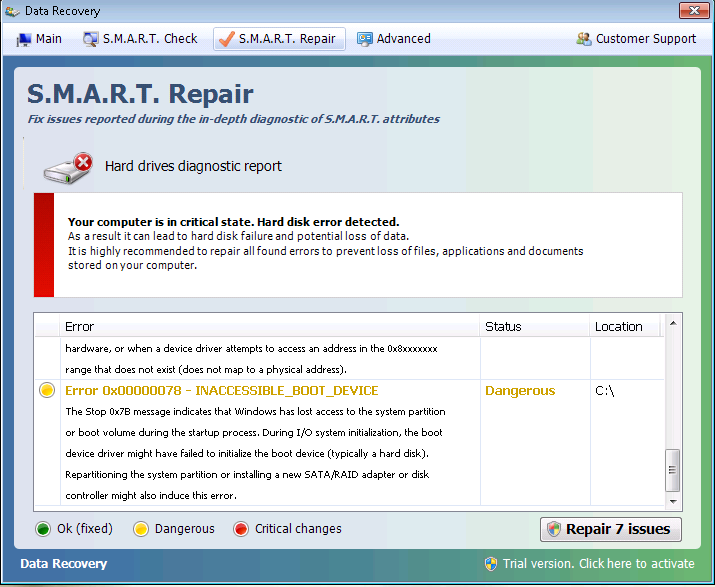
I am not a security expert, nor do I profess to be any sort of virus removal expert, but from time to time we all have to deal with their removal.  A couple of my earlier articles relating to viruses seem to be popular so I thought I would share my latest conquest. Perhaps not the best method but it worked for me. This one reared its self as a popup warning with “S.M.A.R.T. Repair” and advised of hard drive issues.  This is another variation of the “FakeAlert” virus that has been known over the last number of years as XP Security 2011, Security Shield, XP Antivirus 2010, MAC Security, and so on.

image

Generally best practice is to remove a drive and attach it to another computer for scanning or as a minimum boot to safe mode.  However, we do not always have that luxury and often have to try to repair remotely such in this case….

  • My first step was to login as a different user than the one that was recently infected 

Often the virus will not be active within another user’s profile, at least not until triggered.  The most common trigger being accessing the internet with a browser.

  • Next I created an additional admin account as soon as possible

This may or may not be possible at this point depending on the virus, but when it becomes option I do so incase this account gets infected and I have to start over.

Most often I try to do a system restore right away.  Though this will not completely remove a virus, often it will disable it to allow you to do a thorough clean up with tools like Malwarebytes, TDSSKiller, and other anti-malware apps.  You may have only seconds to start system restore after logon before the virus gets up and running and disables it. In these cases you can add a shortcut to the All Programs / Start Up folder with the following path %systemroot%\system32\rstrui.exe so that it automatically starts at logon, then log off and back on.  It seems in many cases if you can get to the second window of System Restore before the virus completes its ‘boot up sequence’ it will run.  In other cases it is either completely disabled, or all restore points have been removed.

I had read this virus removes desktop items and program menu items and puts them in a temp folder.  In this case do not use a temp file cleaner and not knowing where or how the files were stored, I didn’t want to use System Restore.

  • Next step was to copy Malwarebytes from a network share, and run.

Do not use a browser on the infected PC to download Malwarebytes as the browser will often trigger installation of the virus in the current user profile.  I usually at this point run it in “Quick Scan” mode.  There is a good chance this will kill the virus.  It did so in my case, and does require a reboot.

image

  • Upon reboot I ran TDSSKiller to check for any root kits.

In this case it was clean.  The virus also had hidden many stem files and short cuts.  For this,,,

  • I use an application called “Unhide” which returned hidden files and shortcuts to a viewable state.

In some cases you may have to locate folders and manually unhide all files within the folder and subfolders using a command window and   attrib  -H  *.*  /S /D   This virus also removed all personal desktop items, and all items within the folders of the Start Menu of the infected user.  Based on the log file generated by Unhide, it may have restored these had I been logged in as the user when it was run.

Now logged in as the infected user, I was able to manually restore their missing desktop and Start Menu items by 

  • Copying the missing files from C:\Users\<infected user name>\AppData\Local\Temp\smtmp\1, & 4 to their appropriate locations
  • I also had to manually add back start menu items such as My Music using the properties option of the task bar
  • Next verify any existing anti-virus and/or anti-malware software is running, if not you may have to re-install
  • Final step was to run a Malawrebytes “Full Scan” while logged in as the infected user.

All of this was performed remoty and apparently successful, but always remember “once infected, always suspected”.  You can never be 100% sure the system is perfectly clean unless you do a full wipe and restore.

An excellent site for troubleshooting all types of viruses is bleepingcomputer.com  and if interested in reading more about the FakeAlert viruses, and how you were infected see: “Stopping Fake Antivirus: How to Keep Scareware off Your Network

Ping command…..needs to close

I had a client today advise they were unable to send or receive e-mail using Outlook.  Upon initial inspection this was the case and Outlook showed as disconnected (using Exchange).  There were no other obvious issues, web browsing and all network services “seemed” to be working properly.  However, there were frequent pop-ups with the message:   

TCP/IP ping command has encountered a problem and needs to close

Pinging did work fine, for the record. While doing a quick search for possible solutions I came across many others with a similar problem, so I thought I would take a moment to post my findings. 

The Event logs had additional errors the key one being:  Event ID: 4226,  Source: Tcpip,  TCP/IP has reached the security limit imposed on the number of concurrent TCP connect attempts.

Though there could be other causes, this usually indicates some sort of malware, as confirmed by EventID.net 

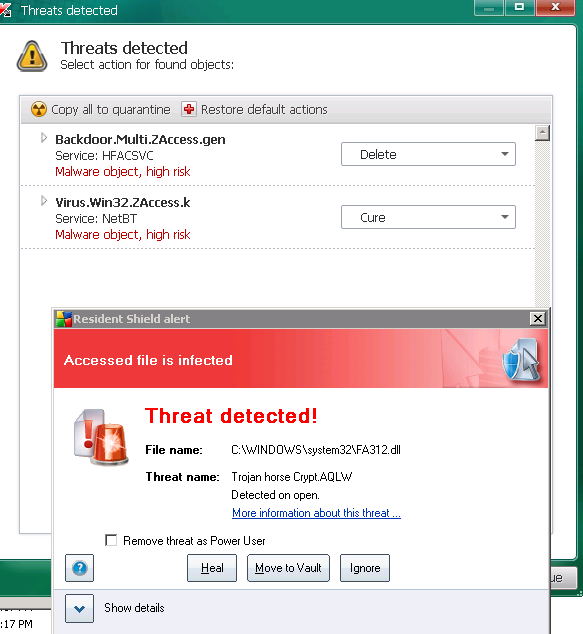
Kaspersky’s Anti-rootkit utility TDSSKiller located 2 viruses, and AVG a third as shown in the image below. Keep in mind other viruses could present themselves in the same way.  Clearing all temp folders and a full scan by multiple other malware detection apps did not reveal any other issues, but one must always be concerned that “once infected, always suspected”.   Outlook now worked properly with no repairs required to the application or networking.

image

Connect to Windows VPN at Logon

The internet is littered with questions about VPN connection and authentication issues as a result of using cached credentials.

  • How can I automatically connect my Windows VPN at start up?
  • Why do I have to re-enter my user credentials when connecting my corporate VPN?
  • How do I get Group Policy to apply to VPN connected users?
  • How do I use my work domain user account when I work from home using a VPN?
  • Why won’t my logon script run when connecting by VPN?

You can connect from any PC using a VPN, but in most cases you do so after having logged onto the PC first. If this is a “domain joined” corporate PC, when you logon without the domain controller present, you are not authenticating to the domain but rather using the credentials cached on the local computer from a previous logon.  As a result Group Policy cannot be updated, logon scripts are not applied, and most often you have to re-enter your user credentials when you do choose to connect to the office via VPN.

It is possible to connect to the VPN at logon resulting in an experience similar to that of the office, except of course for the reduced file transfer speed,  However, there are few conditions that must be met to do so:

  1. This applies only to the Windows VPN client. Newer Cisco VPN clients and a few others do offer methods to connect the VPN before logon, but they use different processes.
  2. The computer must be a member of the domain, and therefore Pro, Ultimate, or Enterprise versions of the operating system.  At logon you will be providing domain credentials which are automatically passed to the local logon, thus they must be the same.  Using the same username and password is not enough as logon credentials include domain or computer names.  Domain\JDoe is not the same as LocalPCname\JDoe.  If the computer is not already a member of the domain, it is possible to join a remote domain using the VPN connection.  To do so please see:  https://blog.lan-tech.ca/2012/07/25/how-to-join-a-windows-domain-using-a-vpn/
  3. Should the PC not be domain joined and you wish to automate the VPN connection, after logon, please see: https://blog.lan-tech.ca/2013/06/08/rasdial-automate-vpn-connections/
  4. When you create the VPN connection you must check the box “allow other people to use this connection”.

image

Having met these conditions, at logon there is now an option to connect using the VPN during logon.

Windows Vista and Windows 7:

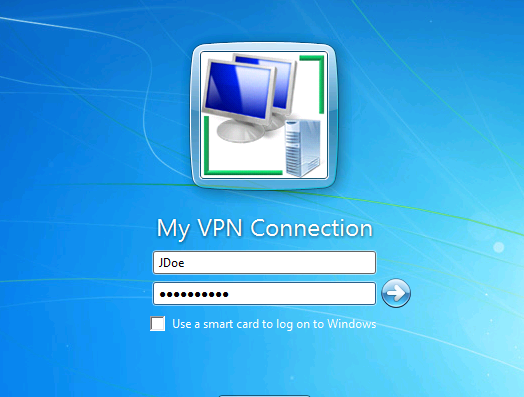
At logon select “Switch User” and a new blue icon will appear in the lower right next to the familiar red Shut Down icon.

image

Clicking the icon will allow you to use the VPN connection, and simultaneously connect and authenticate to the corporate domain, and log on to your local PC

image

Windows XP:

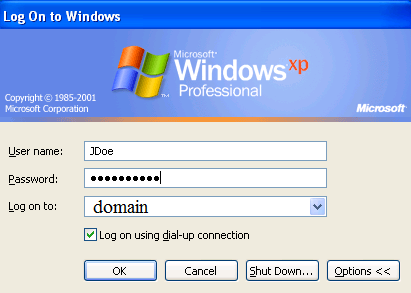
At logon after pressing ctrl+alt+del, if you click the “Options” button there will new be a check box “Logon using Dial-up connection” which will use the VPN connection, and simultaneously connect and authenticate to the corporate domain, and log on to your local PC

image

Windows 8:

Please see the more recent post to enable on a Win 8 PC

Slow Links:

Depending on the performance of the VPN connection, it is sometimes necessary for the network administrator to “tweak” a few Group Policies for slow network detection.  The following policies can assist with this:

Server 2008 / 2008 R2 / SBS 2008 / SBS 2011:

  • Computer Configuration | Policies | Administrative Templates | System | Group Policy | Group Policy slow link detection
  • Computer Configuration | Policies | Administrative Templates | System | Scripts | Run logon scripts synchronously
  • Computer Configuration | Policies | Administrative Templates | Network | Offline Files | Configure slow-link mode
  • Computer Configuration | Policies | Administrative Templates | Network | Offline Files | Configure slow link speed

Server 2003 / SBS 2003 / SBS 2003 R2:

  • Computer Configuration | Administrative Templates | System | Logon | Always wait for the network at computer startup and login
  • Computer Configuration | Administrative Templates | System | Group Policy | Group Policy slow link detection
  • Computer Configuration | Administrative Templates | System | Scripts | Run logon scripts synchronously
  • Computer Configuration | Administrative Templates | Network | Offline Files | Configure slow-link mode
  • Computer Configuration | Administrative Templates | Network | Offline Files | Configure slow link speed

Client Deployment:

Network administrators may also want to considered creating a deployable VPN client for consistency, security, and with a company logo.  An earlier post outlines how to do so in detail:

https://blog.lan-tech.ca/2012/01/30/windows-vpn-client-deployment/